Three chapters of a book became seven phone-sized visual-novel videos in one week, and every motion in them was judged on a phone first.
The book is Harry Potter and the Sorcerer's Stone, and the videos run about 45 minutes in all. The surprising part is not that a script can do this. It is how the videos stopped feeling like slideshows: every single motion was shown twice on a phone, before and after, and a person tapped Keep, Tweak or Cut. Out of 65 motions, 57 survived.
Here is the week in under five minutes, told as a visual novel about making visual novels.
What you are looking at
A visual novel tells a story the way a game does. A painted background fills the screen. Characters stand in front of it as cut-out figures and change expression as the story turns. The words appear in a frosted-glass reading window at the top, typed out one word at a time in step with a narrator and a separate voice for each character.
Quoted speech is spoken by the character, word for word. The rest is narration taken from the book. Seven narration lines were restated in new words, because a voice engine's copyright filter refused the original wording. Everything else follows the page.
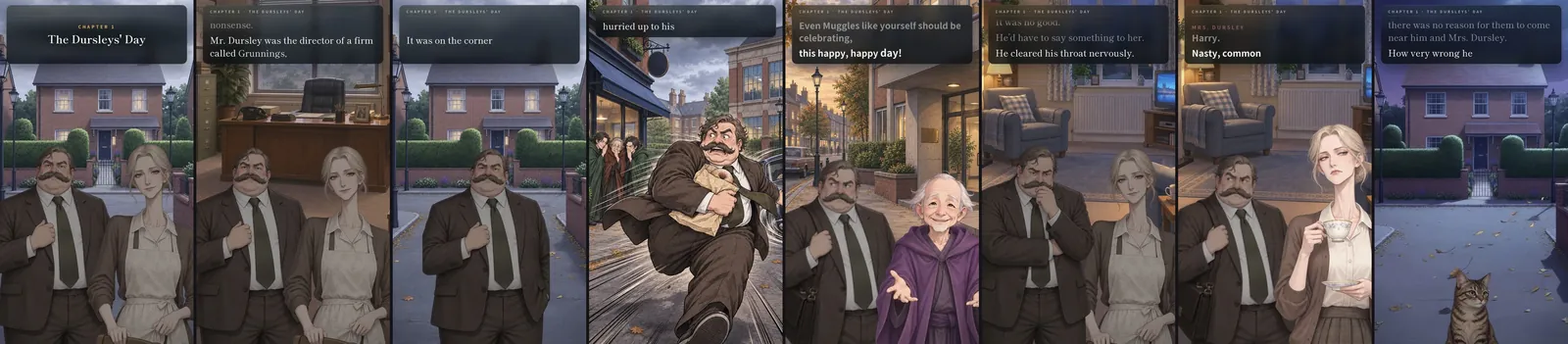
*From the title card to the cat on the wall at night. The ink-drawn frame in the middle is an action panel.*
The week, day by day
- 22 to 23 September. Two agent threads built different parts of the pipeline side by side. Both edited the same instruction file without knowing about each other, and the art drifted apart.
- 24 September. The two threads were merged into one system: one style anchor for the whole series, Gemini voices for adults, a Qwen voice model for children, planned sound from a free library, a shared motion timeline, and a faster renderer. Chapter 1 was drafted over the next day, and a Chamber of Secrets clip was cut into four TikTok parts, with Part 1 posted.
- 25 September. Both parts of Chapter 2 were drafted. Then came the question behind this whole post: how do you make these grab attention on a phone without spending more on art or voices?
- 25 to 26 September. The answer was a motion library, judged in five review galleries. The moves that survived became a polish pass for the four finished parts. Chapter 3 was planned, drafted in three parts, scored with generated music, and had its sound levels fixed by measurement.
- 27 September. Fights, chases and floods got their own ink style. Dead openings were replaced. Harry got pyjamas for the night scenes. All seven parts were rendered again.
Art that stays on model
The biggest early problem was that the same character looked different from clip to clip. The fix was a set of rules for how every picture gets made.
Dumbledore was drawn in four candidate styles, and one of them became the anchor that governs every image since.
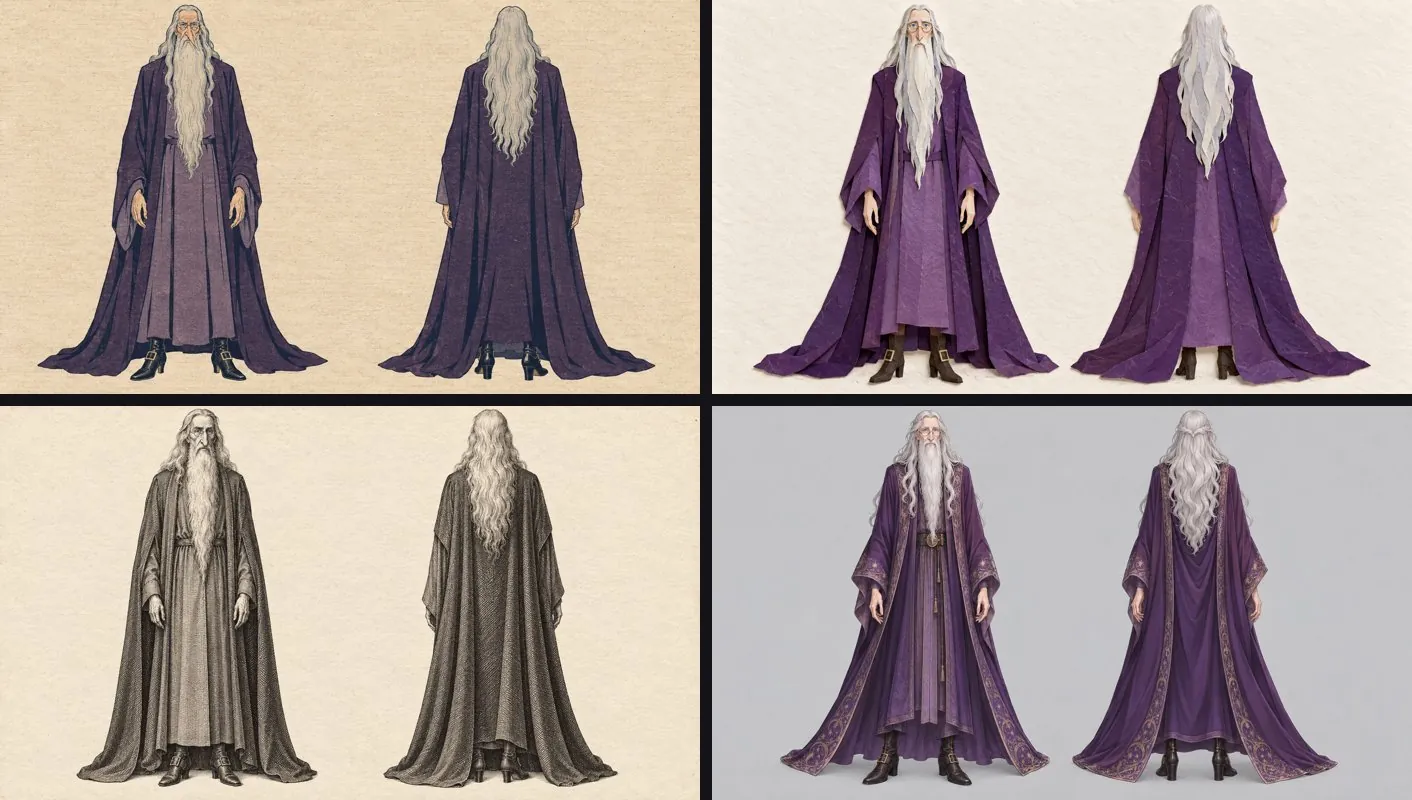
*Ukiyo-e, cut paper, engraving, and the painterly style that won, at bottom right.*
Every character has a front-and-back turnaround sheet. Harry has one as an infant and one for each age from 10 to 17, so later chapters can age him without guessing.
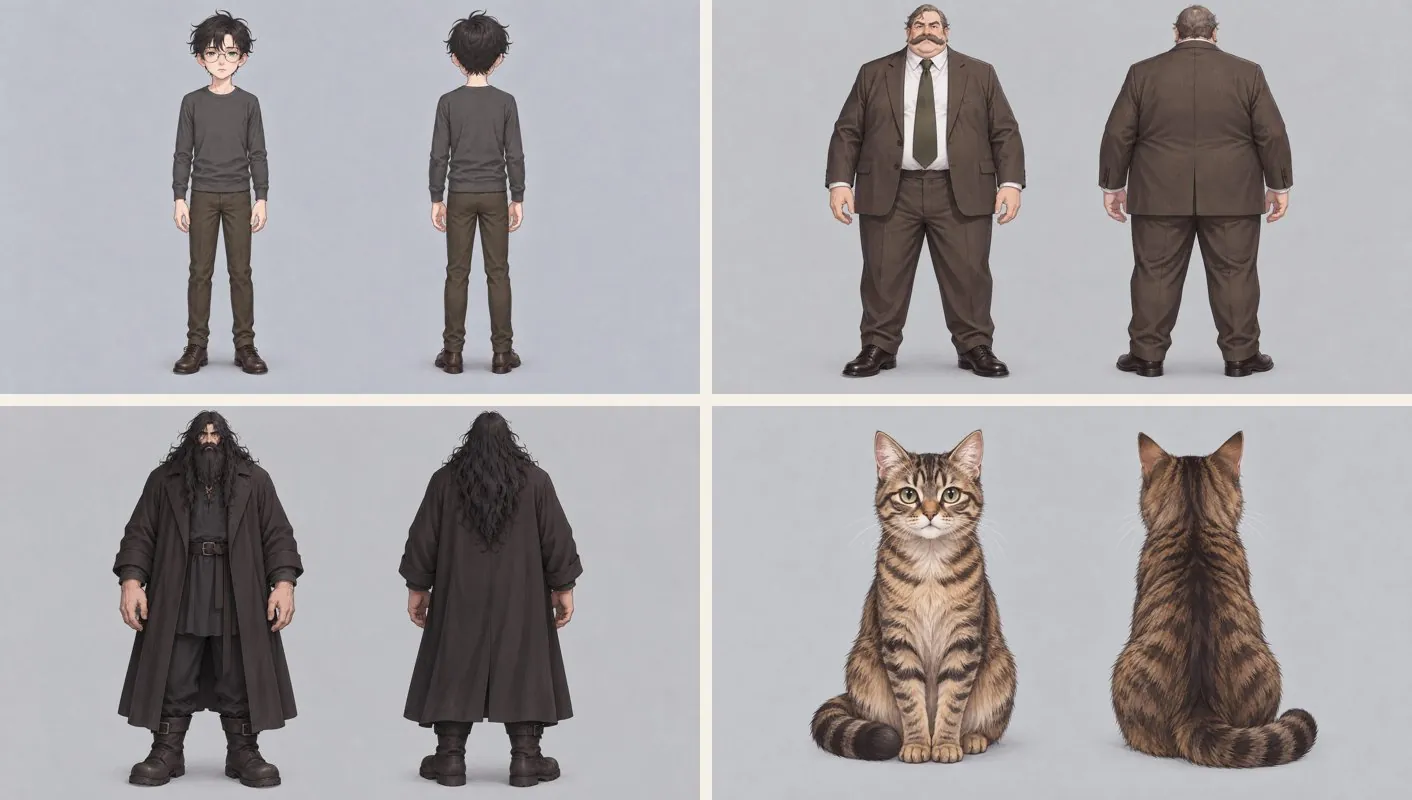
*Front and back views lock each character's look before any scene is drawn.*
Each clip gets a fresh two-by-two pose sheet with the four poses its scenes actually need. Older sheets only lock identity and style. Characters are no longer always standing either: Harry sits on his bed and holds the envelope.
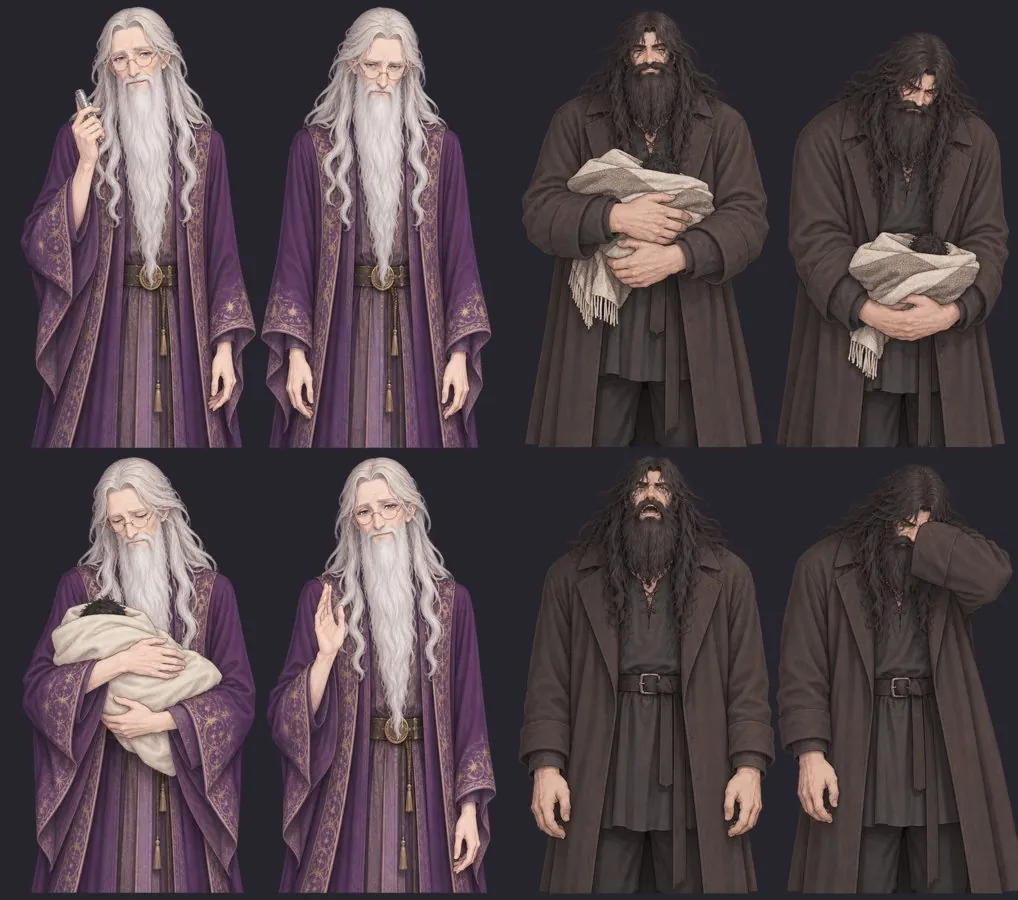
*Four poses per character, cut out and ready for the engine.*
Every image is generated with its reference pictures attached. A gate then compares its colours against the anchor, and a person checks the faces before it goes into a video.
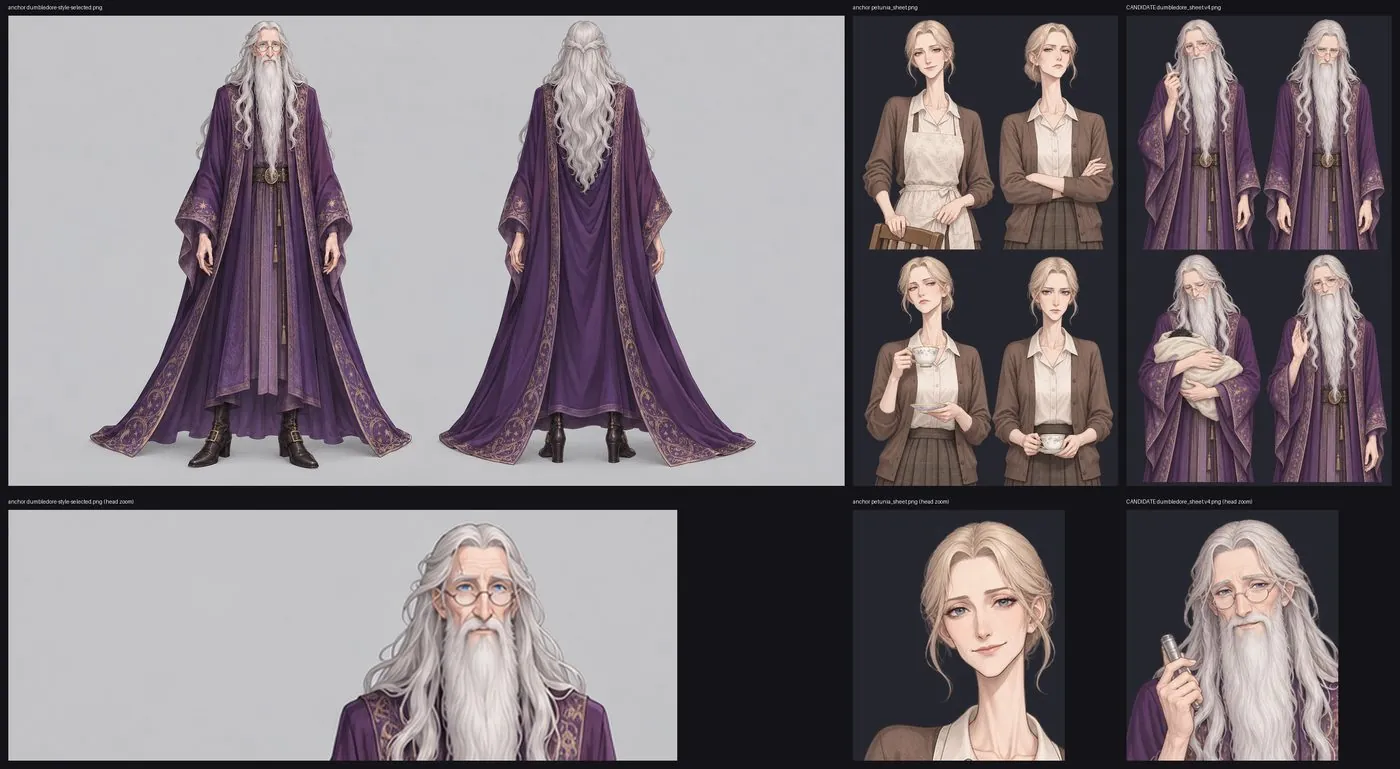
*The anchor, an approved sheet and the new candidate side by side, with head close-ups for the face check.*
A voice for every character
Adults are voiced with Gemini's text-to-speech. Children use a Qwen voice model running on a rented GPU, because the adult engine sounds wrong for an eleven-year-old. If the adult engine refuses a line, it falls back to the other one, and the tool writes down why. The narrator is a clone of one voice across the series: an ElevenLabs voice in Chapter 1, then a Qwen copy of it in Chapters 2 and 3, because Gemini's copyright filter refused long passages read straight from the book.
Each voice is designed once from a written description. Vernon's reads: "A middle-aged English man from Surrey with a deep, broad speaking voice". A test line is recorded and listened to before any real line.
Three rules keep the voices cheap and in sync. Every recording is cached, so re-rendering a part reused almost every take. Each word is timed on the same trimmed audio the video plays, because timing the raw recordings put the text up to a second behind the voice. And a take is never cut in the middle: a pause can only go after a line's last word, and the checker refuses anything else.
Judged on a phone
This is the heart of it. Each new motion became a card with the same moment shown twice, before and after, as a full-screen phone clip. The reviewer swiped through like a video feed and tapped Keep, Tweak or Cut.
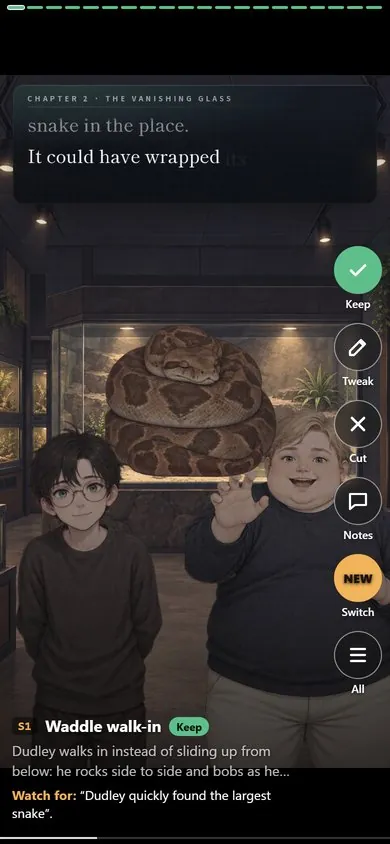
*One clip at a time, full screen, with Keep, Tweak, Cut and a switch between the old and new version down the right edge.*
Across five galleries, 65 motions were reviewed. 57 were kept, 6 were cut and 2 were tweaked.
- The reading window. 17 cards: 15 kept, 1 tweaked, 1 cut. Text got bigger, in a three-line window. The author's italics came back from the ebook. Whispers type slower, shouts shake the window a little. The one cut was "page mode", which cleared the window at every change of speaker.
- Sprites. 22 moves demoed on real Chapter 2 lines: 19 kept, 1 made bigger, 2 cut. Dudley waddles in, Vernon looms, a knock bumps the whole picture. The planner now turns the verbs in the prose into moves, capped at eight a minute.
- Pacing. 7 tools demoed, 4 kept: a pause after a line, a slower tense scene, a slow-motion peak, and the music dropping out before a big line.
- Camera. All 12 moves kept. A slow creep and a little parallax are now on for every video.
- Atmosphere. 6 of 7 kept. The night fog was sent back to be made thicker.
One card shows the idea best. Chapter 2 Part Two used to open on black, then an empty car. Now the title sits in the reading window from the first frame, with Harry already in his seat.
Before a polish render, every new move is checked in stills: four frames around the word it fires on.
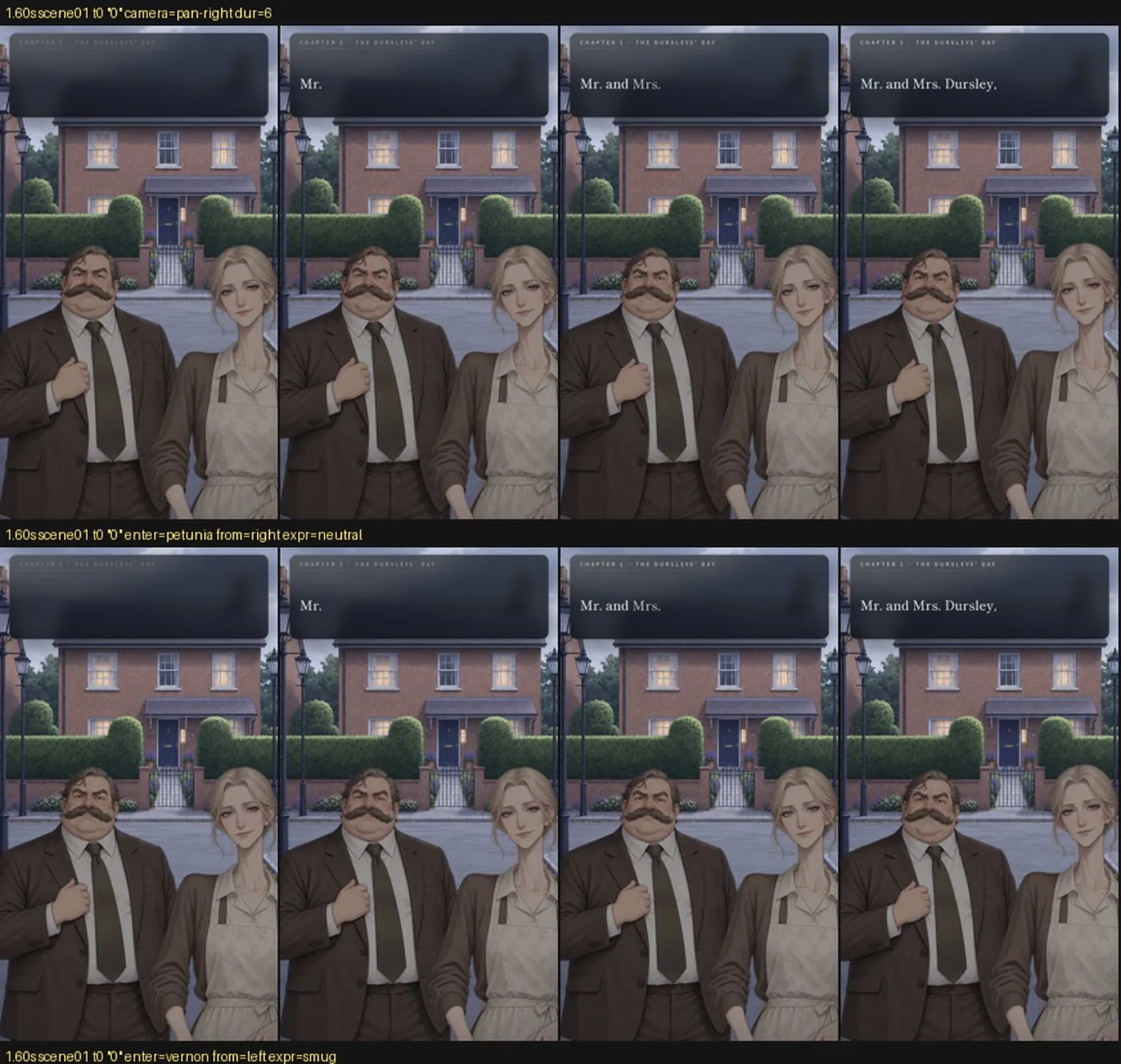
*Each row is one move, labelled with the move and the word it fires on.*
Action gets its own ink
Cut-out figures are made for conversation. When the narrator described Vernon wrestling Dudley for a letter, the old video showed two people standing with their arms folded. So action became its own kind of scene, drawn in an ink comic style: bold outlines, hatching, speed lines, same characters and colours.
When bodies touch, the beat is one full painted panel, because two cut-outs cannot grip each other. When one body moves, an action pose charges across an ink version of the room. Every verb gets a sound, the camera resets on each panel cut, and the cut back to the painted room tells you the fight is over.
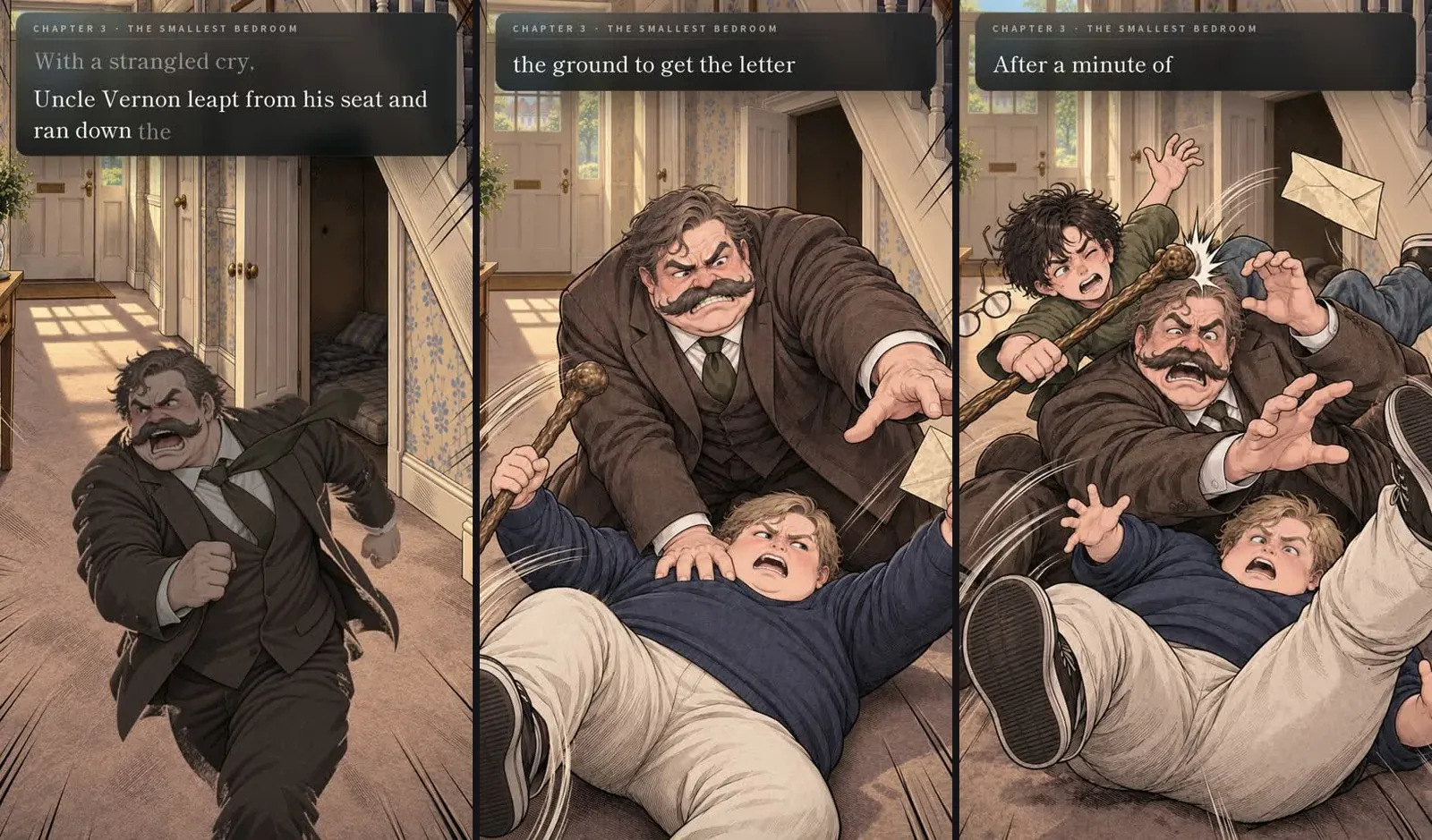
*Vernon charging, Vernon pinning Dudley, and the tangle with the stick.*
Once the method existed, it went back through the earlier chapters.
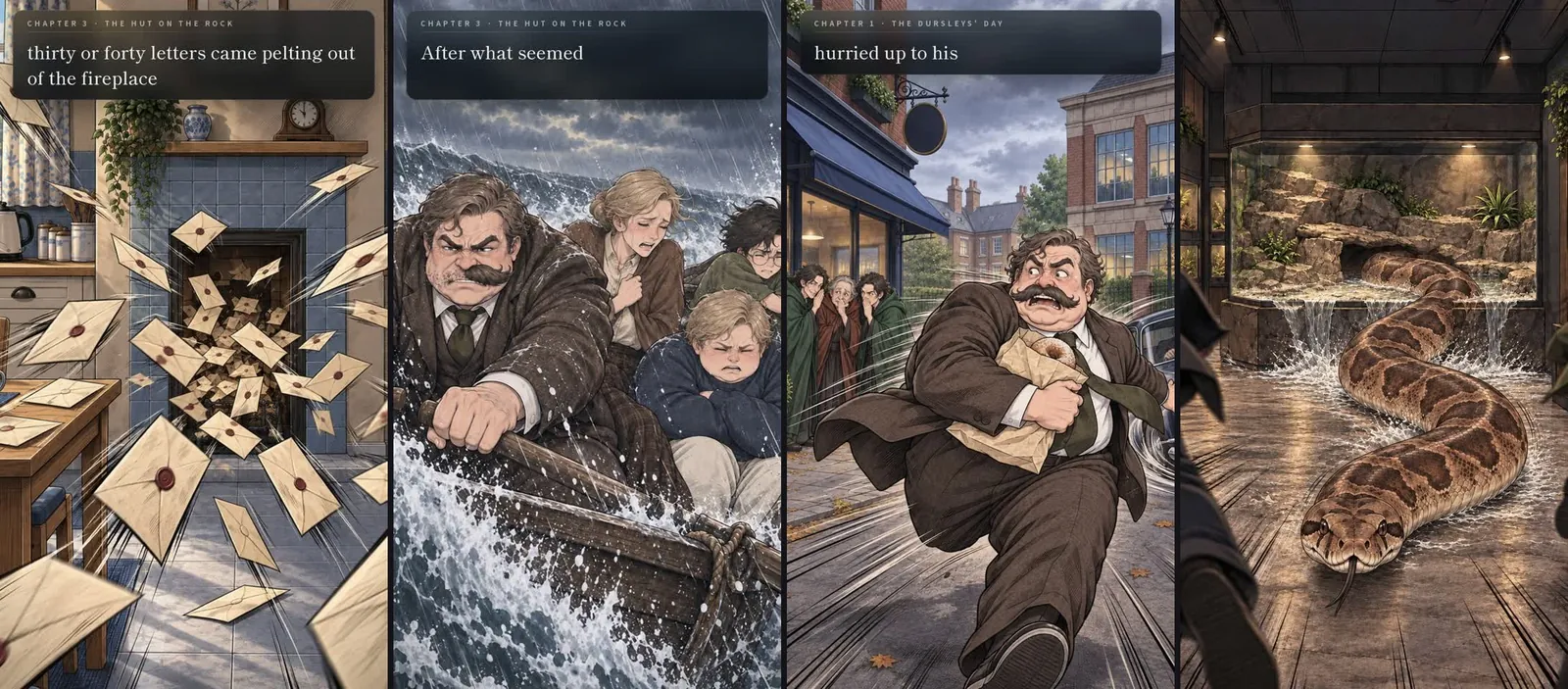
*Letters pouring from the fireplace, the rowboat in a storm, Vernon dashing with a doughnut, and the boa sliding out of its tank.*
No dead first minute
On a phone, the first second or two decides whether people stay. Several parts opened on an empty street or a black frame. Every opening was rebuilt with pictures, staging and sound only, with no new voices. Chapter 1 Part One now cuts to Vernon's office, to little Dudley, and to a dusty photo of the two sisters in its first minute.
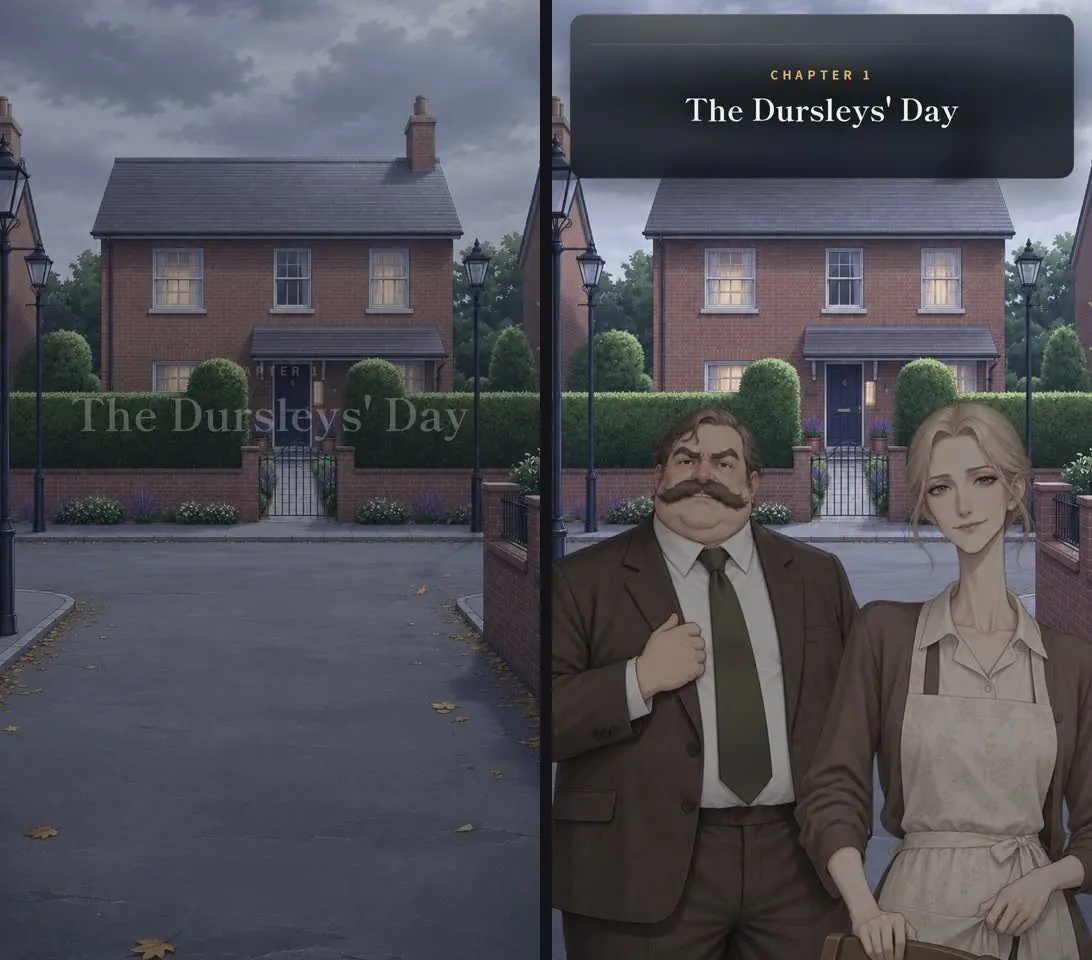
*Left, the draft opened on an empty street. Right, the final opens on the Dursleys with the title in the reading window.*
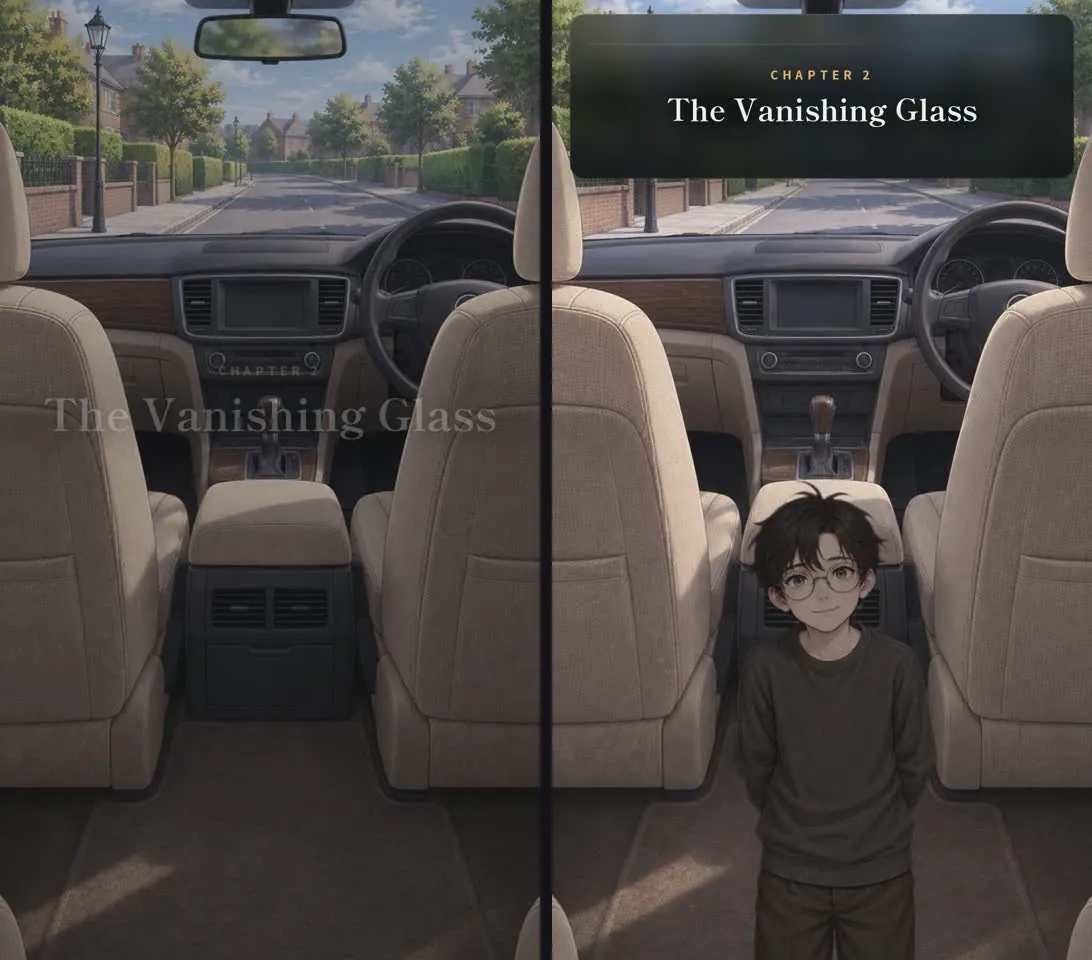
*Left, the draft opened on an empty car. Right, the final opens with the title in the window and Harry in the back seat.*
Sound, music and the renderer
The sound effects measured 11 to 22 decibels quieter than the voices. Now each effect is measured and set against the dialogue. Six music tracks for Chapter 3 came from an open music model on a rented GPU, about 15 seconds of compute each, and every track is filed under a motif so a feeling can be reused instead of generated again. That week the library had five motifs.
The old browser-based renderer took about 15 minutes for a five-minute film, and any change meant starting over. A home-made renderer was benchmarked against it on 24 September and was about 2.4 times faster on a first render. It also caches each scene, so editing one scene only re-renders that scene.
The framework, if you want to try it
- Plan before you make anything. A reader page shows the whole adaptation beat by beat. Chapter 3 was planned and approved in six decisions before any money was spent on it.
- Draft for content, then polish for motion. The first render is only about the words, voices, art and sound. Motion comes in a separate pass, after the content is approved.
- Judge every move in isolation, on the device people will watch on. Before and after, same moment, one tap. Keep, tweak or cut.
- Write the rules into the tools. A take is never cut mid-line. A face hidden behind another character's body fails the layout check. 38 changes landed in the system's instruction files that week, each one a rule every future chapter inherits.
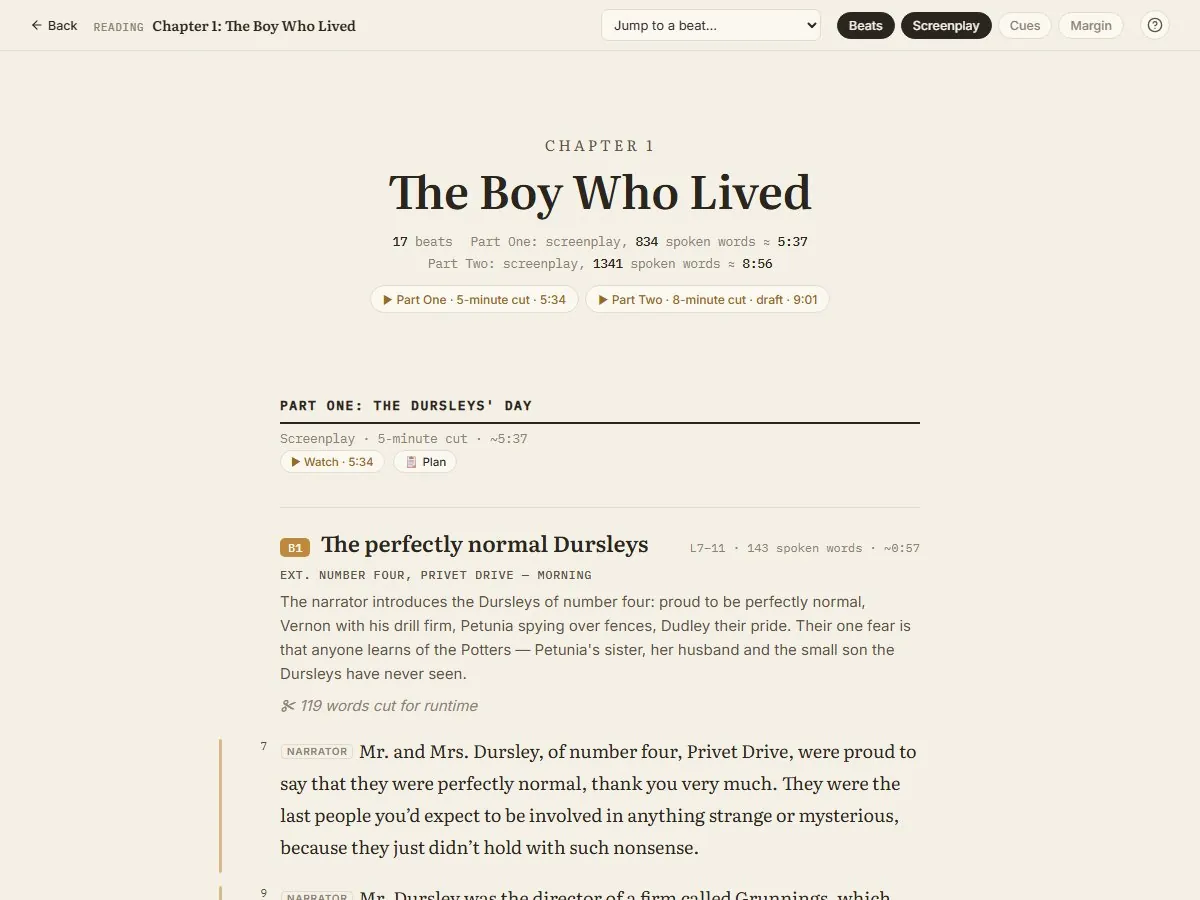
*The adaptation beat by beat, with runtimes per part, read and approved before anything is voiced or drawn.*
Limitations
- This is a fan adaptation of a published book. It narrates the book's text, which carries real copyright risk on public platforms.
- Seven narration lines are restated rather than verbatim, because a voice engine refused them.
- A cut-out figure cannot swing an arm or move its legs. A punch is a lunge plus a pose change plus a jolt, not a moving fist.
FAQ
Is any of this official? No. It is a fan adaptation of Harry Potter and the Sorcerer's Stone by J.K. Rowling, and it is not affiliated with the author or publisher.
What is AI-generated? The art and the voices, and much of the music. Some music beds in the chapter videos and the sound effects come from the free Mixkit library; the explainer above uses only generated music. The words are the book's, apart from the seven restated narration lines.
How long did it take? One week, 22 to 27 September 2026, for three chapters and seven parts.
Why judge motions one by one? Because a move that looks fine in a thumbnail can be too much at full size, and many small mistakes add up to a video that feels cheap even when no single one stands out.
What comes next
Chapter 4 is next, made with the same draft-then-polish process. Watch the explainer above, and tell us on YouTube which chapter should come next.
*Fan adaptation of Harry Potter and the Sorcerer's Stone by J.K. Rowling. Not affiliated. Art and voices are AI-generated; music is AI-generated or from the Mixkit free library.*